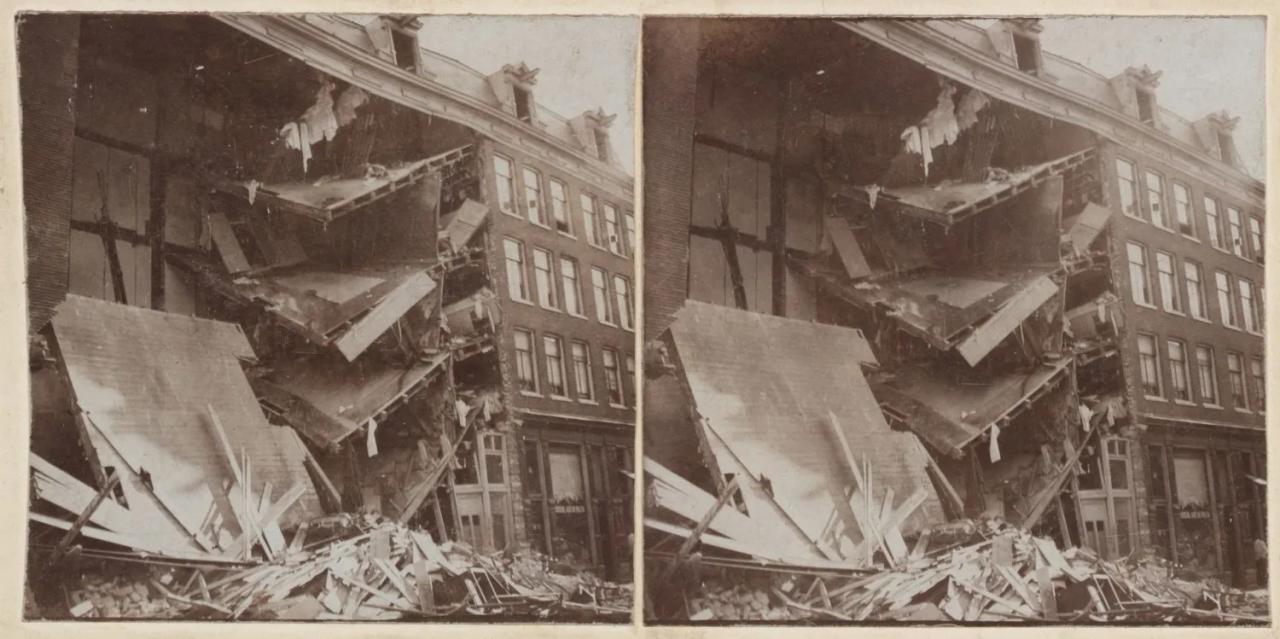
Built on borrowed money
The houses around you went up on borrowed money and in a hurry. From the eighteen seventies onwards, builders here worked on their own account, with mortgages from the banks and in the expectation that the housing shortage would push the rents up by itself. They pressed as many facades as possible into every street, all of the same width and the same height, and that repetition is still there the moment you look down this street.
The pace came at a price. A letter in the Algemeen Handelsblad described four-storey houses with walls a single brick thick, held together by beams as thin as a plank. As early as 1872 the city health commission had warned that the safety of the building workers was being played with.
On 21 September 1876, in the Ferdinand Bolstraat, the street we are heading for, two houses under construction collapsed and took a third one down with them. The city barely supervised what was being built here, and only with the Housing Act at the start of the twentieth century did that change.
We follow this street further west, until we reach the Ferdinand Bolstraat.
Any feedback for this story?