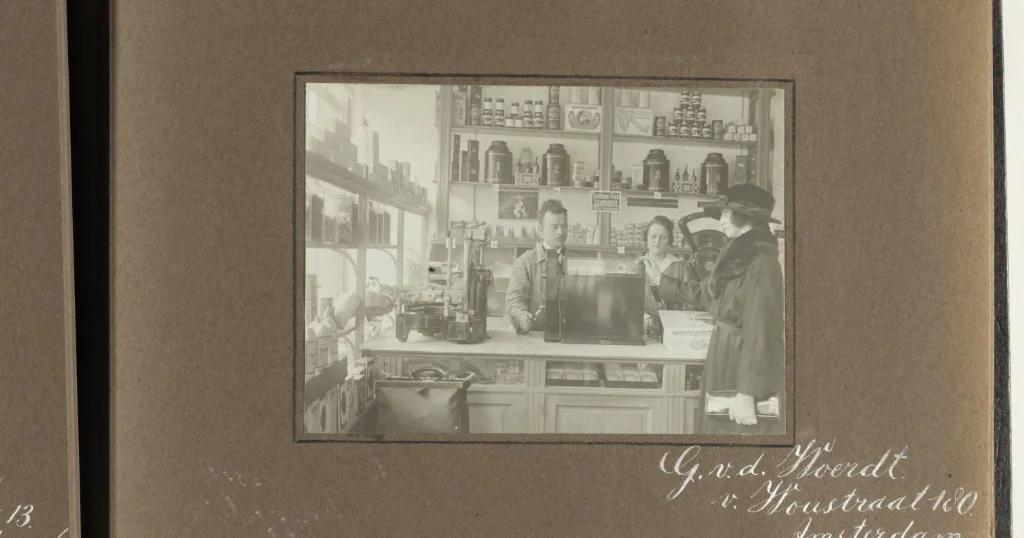
The Van Woustraat
Here the market ends and the walk crosses the Van Woustraat, the shopping street of De Pijp, where the tram runs past and the neighbourhood does its errands. Between the shop windows there is a narrow door every few metres, and behind it the stairs climb to the three or four floors of homes that carry on above the shops.
In January 1941 the occupier ordered every Jew in the Netherlands to register, with a name and an address. Those lists are the reason we now know exactly who lived above these shops in February of that year. At number 188, a little further along this same street, they were Saartje Orgelist and Kaatje Orgelist, born in 1887 and in 1916, and Hartog Gans, born in 1885, all three of whom died in 1942 and 1943. The registration that recorded their names became, two years later, the tool with which they were found.
Looking down at the pavement as you go, you will see brass stumbling stones set among the tiles, each with a name, a year of birth and the place where that person died. Two of them lie in front of number 111, for Engeltje van Leeuwen-Rijne and Betje van Leeuwen, laid in 2021. Across Amsterdam there are now more than four thousand.
We cross the Van Woustraat and follow the Tweede Jan Steenstraat, which takes us in the direction of the Amstel.
Any feedback for this story?