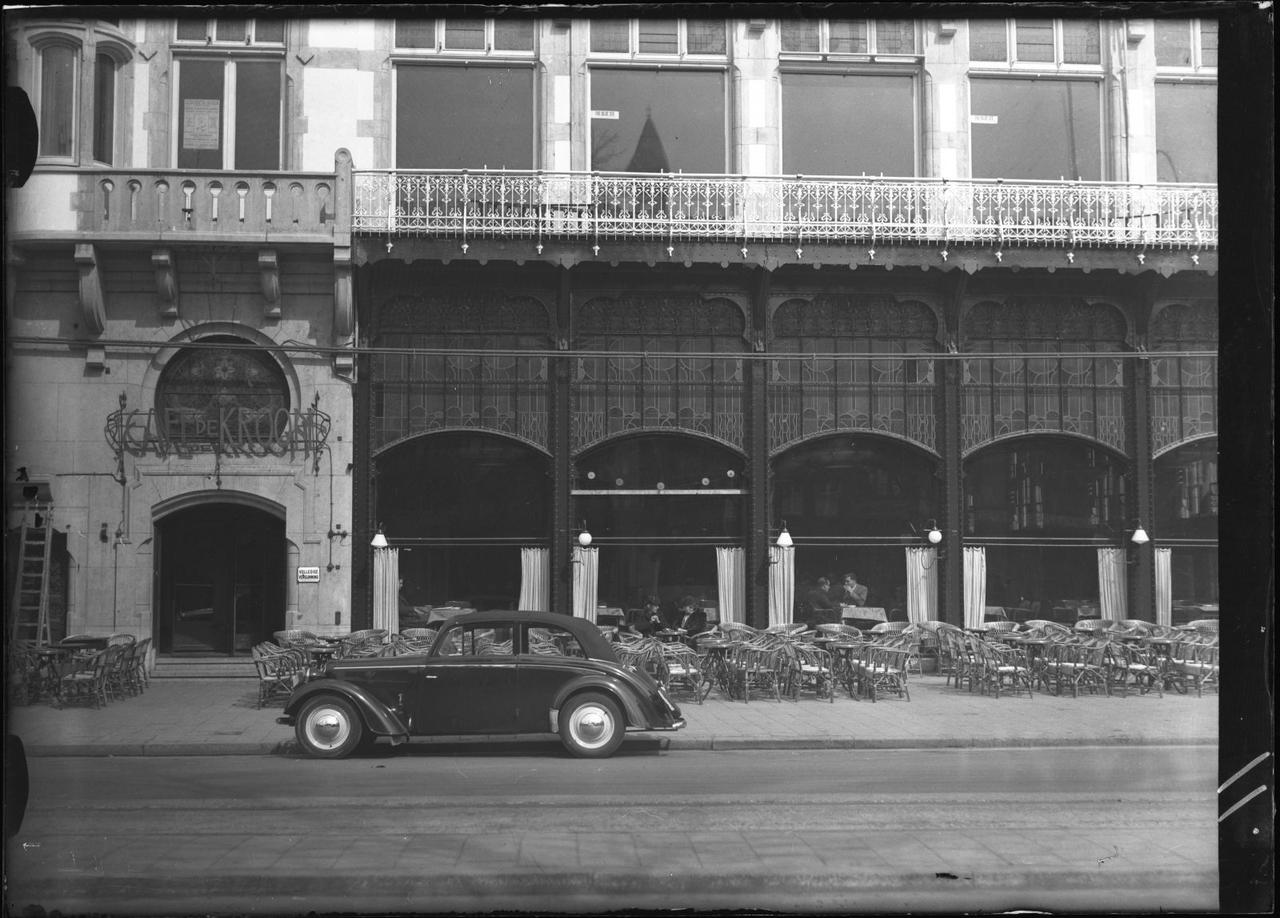
Why the brown café is brown
The brown these cafés are named after is smoke: tobacco and candle wax absorbed over decades by ceilings, panelling and walls, until the whole interior had the colour of an old pipe. Since the smoking ban of July 2008 nothing has been added to it, which means the brown you see today is a sealed layer that records fairly precisely how much was once smoked here.
The second marker sits on the windows, where the name of the house is painted in gold curling letters. Those letters reach back less far than they appear to. Many of them are the work of one man, Leo Beukeboom from De Pijp, who from 1967 onwards painted the city's cafés on commission from Heineken and kept at it for more than thirty years. Anyone who spots a curling letter in the Jordaan, De Pijp or here on the Nieuwe Zijde is probably looking at his hand.
The craft has become rare, and the pubs themselves are having a hard time of it: since 2007 a third of all Dutch brown cafés have gone. Amsterdam is now working to give the survivors protected status, with the bar itself covered by the listing.
We carry on down the Spuistraat towards the Spui, cutting left halfway along to the Kalverstraat, where an unremarkable alley opens just before the end.
Any feedback for this story?