The bridge of the goldsmiths
Halfway across the bridge the rows of shops open up and you find yourself looking out over the water. This is the city's oldest crossing, built at the narrowest point of the Arno, and there were already shops standing on it when the bridge was rebuilt in the fourteenth century after a flood.
Those shops belonged to butchers, tanners and fishmongers, who tossed their waste over the edge into the river below. When Duke Cosimo had a covered walkway built across the bridge so he could move between his offices and his palace, dry and unseen, he found the smell beneath it unbearable, and in 1593 he decreed that only goldsmiths could trade here from then on.
By the open arches you'll find a bust of Benvenuto Cellini, the goldsmith who cast the bronze Perseus, and for years couples in love clipped padlocks to the railing around it, until the city imposed a fine.
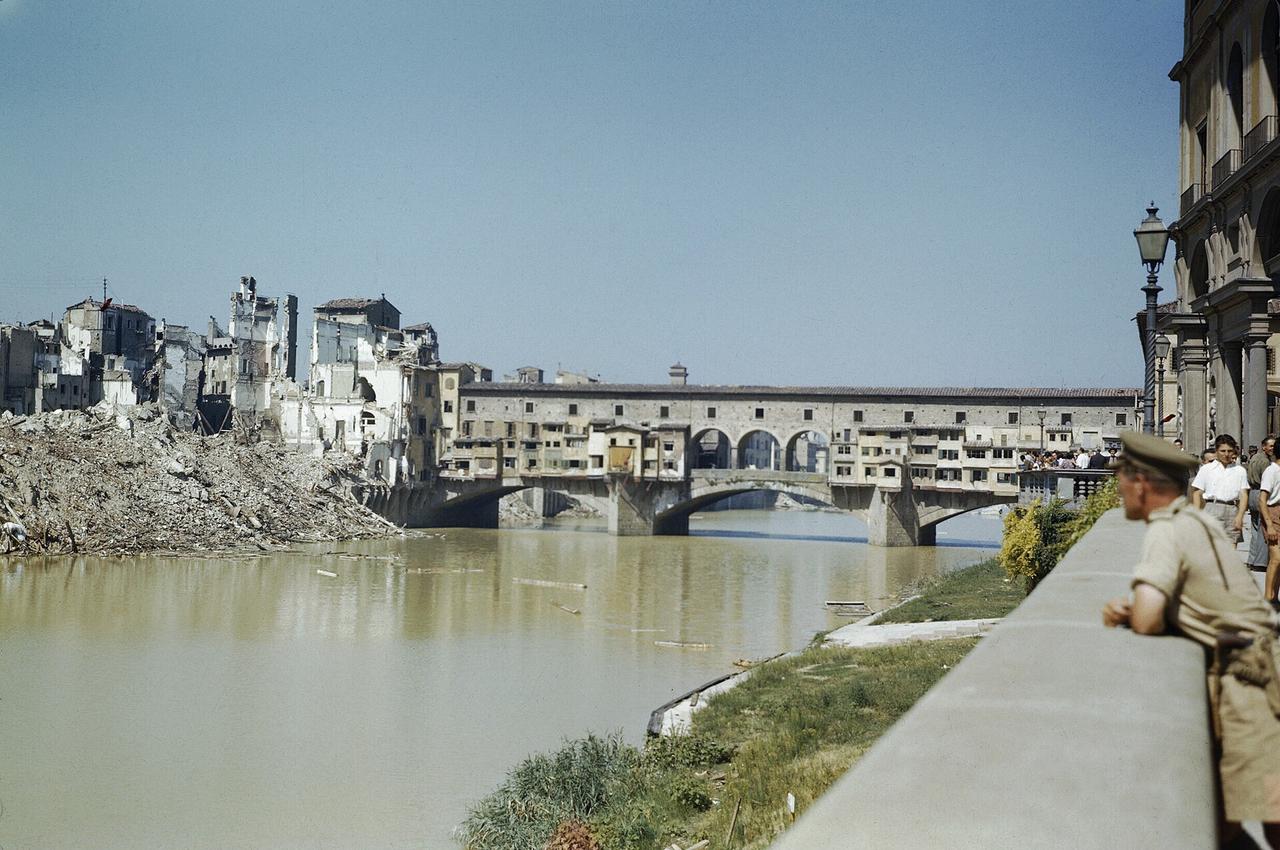
In August 1944 the retreating German troops blew up every bridge in Florence, with this one as the sole exception. The photo accompanying this story dates from the fourteenth of August that year and shows you why: the bridge stands intact between two strips of rubble, because the medieval streets at either end were flattened to block the way through. You'll notice that rebuilding the moment you step off the bridge, where the houses are a good deal younger than the rest of the street.
Follow the embankment downstream to the next bridge, the one with the four statues on its corners.
Any feedback for this story?