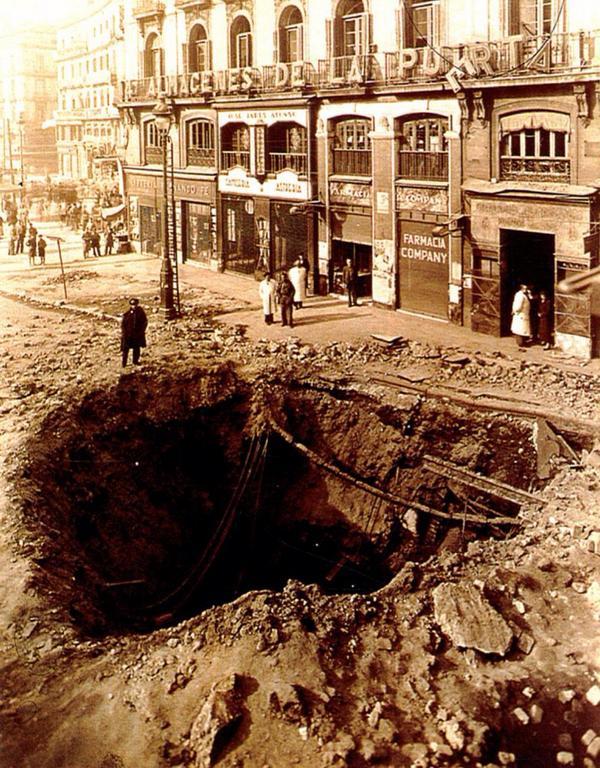
Avenida de los Obuses
The wide street you're standing on now was officially called Avenida de Rusia during the war, though people in Madrid called it Avenida de los Obuses among themselves, Shell Avenue, and that nickname had everything to do with the direction you're looking.
The artillery up on Garabitas was positioned so that the Gran Vía lay directly in the line of fire, and because the street runs dead straight to the east, the shells came tearing down its whole length. The gunners also had a fixed point to aim for, because four kilometres away the tower of the Telefónica, the telephone company headquarters, rose above everything else, so anything within a block of it felt the impact, and whoever had to cross that stretch of street did it at a run.
People adapted, because one pavement was safer than the other and everyone knew it. Shops stayed open, the cinemas kept showing films, and whoever was waiting in a queue scattered when the alarm sounded and then simply rejoined it afterwards.
That's the strange thing about a city under siege: life doesn't stop, it shifts a few metres over.
The Gran Vía carries you further east, as far as the Plaza de Callao.
Any feedback for this story?