Castlefield Basin
You have arrived at the spot where Manchester began, twice. Around AD 79 a Roman cohort built a timber fort on the sandstone above the meeting of the Medlock and the Irwell and called it Mamucium, which is the name the city still carries. Part of the fort and its north gate were rebuilt on the original foundations in 1987, so you can walk up to a Roman wall in the middle of a modern city.
Seventeen centuries later the Duke of Bridgewater had coal in Worsley and no cheap way to move it. His engineer James Brindley cut a canal across the fields, carried it over a river on an aqueduct that people travelled from abroad to see, and in July 1761 the water reached this basin. It was the first true industrial canal in the world. The price of coal in Manchester halved almost overnight, and every mill owner in the country started drawing up plans of their own. The oldest warehouse on the basin opened in 1779, and when the Rochdale Canal came down to meet the Bridgewater at Lock 92 in 1805, this water became the hub of the entire network.
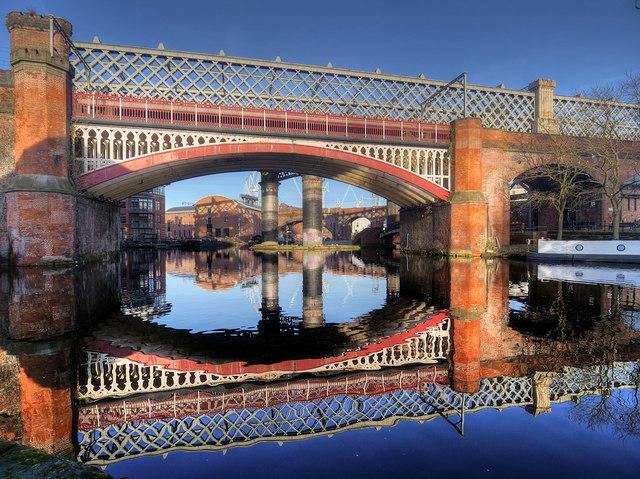
Then look up. Four railway viaducts stride over the basin on cast iron piers, and the Victorian engineers topped them with small stone castles as a nod to the Roman fort below. Stand on the towpath and you have Roman, Georgian and Victorian Manchester in a single view, which is why all of this became the first urban heritage park in the country in 1982.
That is the end of the walk. Water Street is about ten minutes back along the canal, and the bars and terraces around the basin are a good reason to take longer.
Any feedback for this story?