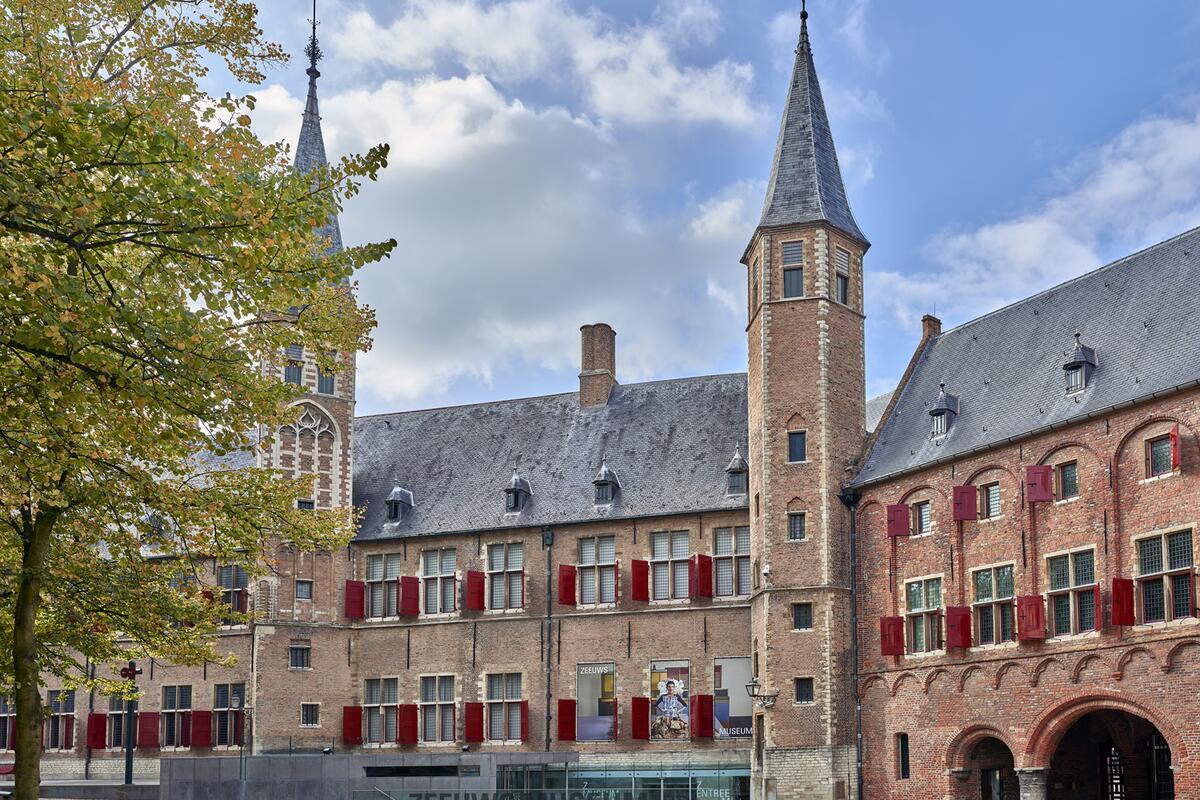
Abdijplein and the Lange Jan
You came in under the Gistpoort, the late Gothic gate in the Sint Pieterstraat. It was built between 1509 and 1512 as the eastern entrance to the abbey, and it carries more names than most gates: Blue Gate, after the hardstone it is built from, and Anchor Gate, after the Den Anker brewery that stood beside it. Three statues look down from above the passage, one of them Count William the Second.
Behind it lies the Abdijplein, the largest former monastery complex in Middelburg. It started small: back in the twelfth century there was a modest priory here, founded by canons from Flanders. When the Norbertine order took it over, it grew into an abbey that for centuries was the wealthiest institution in Zeeland. The abbot became the most powerful man in the region, with estates spread across the whole of Walcheren. Since 1574, the building has been home to the provincial government.
In 1650 the complex gained a school that came close to being a university. The Tussenkerk, the church between the two others here, housed the auditorium of the Illustre School, which in its better years held chairs in theology, law, medicine and astronomy. Middelburg had narrowly missed out on a real university in 1575, when William of Orange gave that honour to Leiden instead. In 1808 King Louis Napoleon banned the appointment of new professors, and that was the end of it.
The tower rising above it all is the Lange Jan, and it has had a rough time of it. It burned down three times: first in 1568, then in 1712, and again in May 1940, the same fire that we heard about at the start of this walk on the Markt. The 1712 fire took all the bells with it. Of the carillon cast in Amsterdam afterwards, exactly one bell still hangs in the tower, the bourdon, weighing just over six thousand kilos. In May 1940 it fell into the rubble, and it was restored, rehung, and rings to this day.
Leave the square on the west side, through the Fluisterpoort, and carry on to the Korte Burg, where we stop for a moment.
Any feedback for this story?