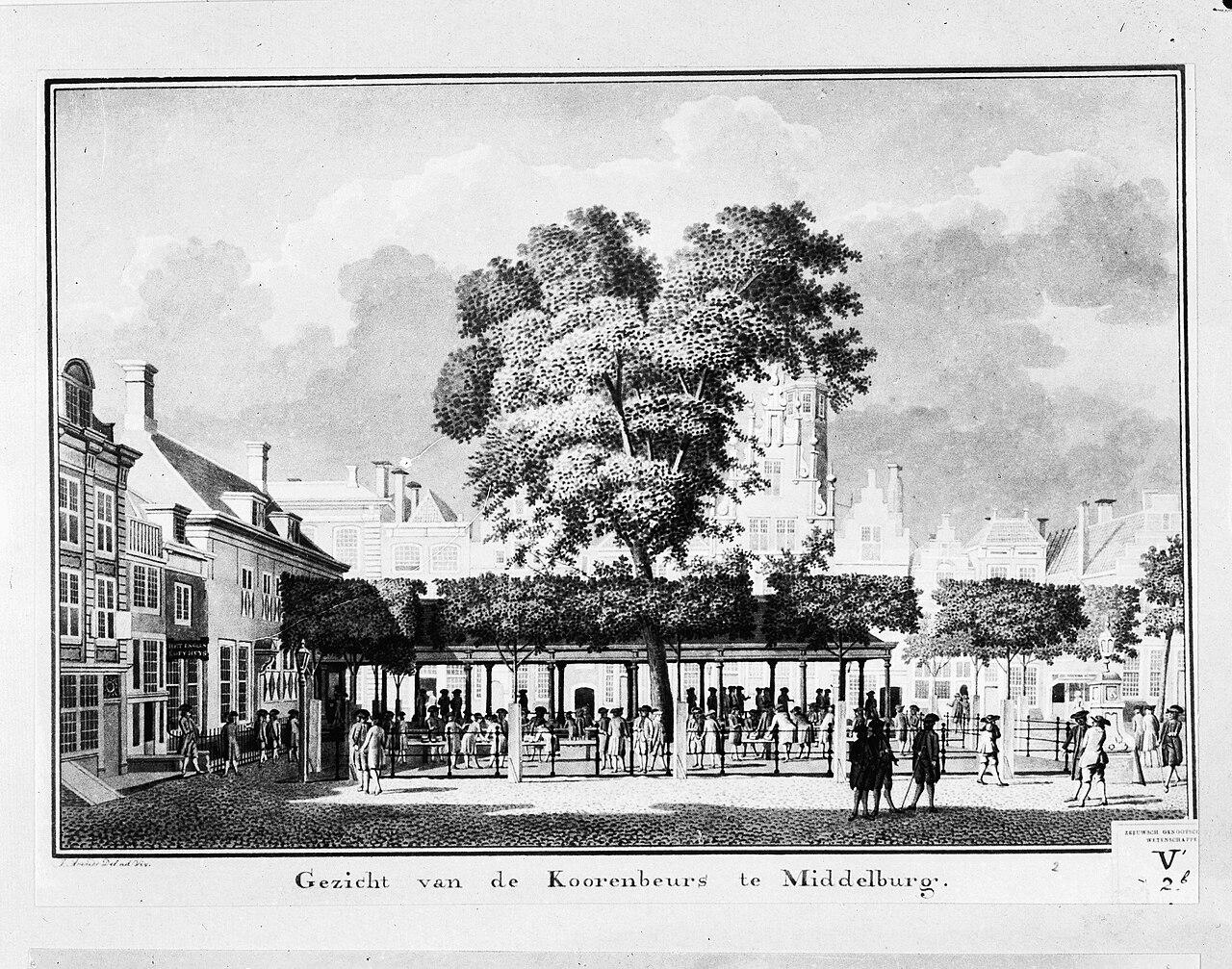
Damplein and the grain exchange
This square is younger than almost everything else we've seen today. Until the late 1960s it was just a normal street of houses, with a nineteenth-century cast-iron grain exchange standing among them. Between 1968 and 1972 all of it came down, because the city needed parking space. Around fifty buildings disappeared, and this time the cause was the car rather than war or tight budgets.
What the city put back is the Korenbeurs you see in front of you, a reconstruction of an eighteenth-century predecessor on the same spot. In 1976, the Middelburg artist Marinus Boezem declared it a stage for art, a place where anyone in the world could come and exhibit something.
That immediately caused trouble. A Belgian artists' collective installed a piece they called a radioactive monument. It was a lead cylinder, and inside the cylinder sat a ping-pong ball painted with radioactive paint. The authorities panicked and had the cylinder cracked open to see what was inside.
In doing so, they did exactly what the artists were hoping for. The work was about how a government responds to something it can't see and doesn't understand. They got their answer.
We cross the square and head west for about a hundred and fifty metres. When we reach the Abdij, the medieval abbey complex at the centre of the city, we pass under the Gistpoort and out onto the inner courtyard.
Any feedback for this story?