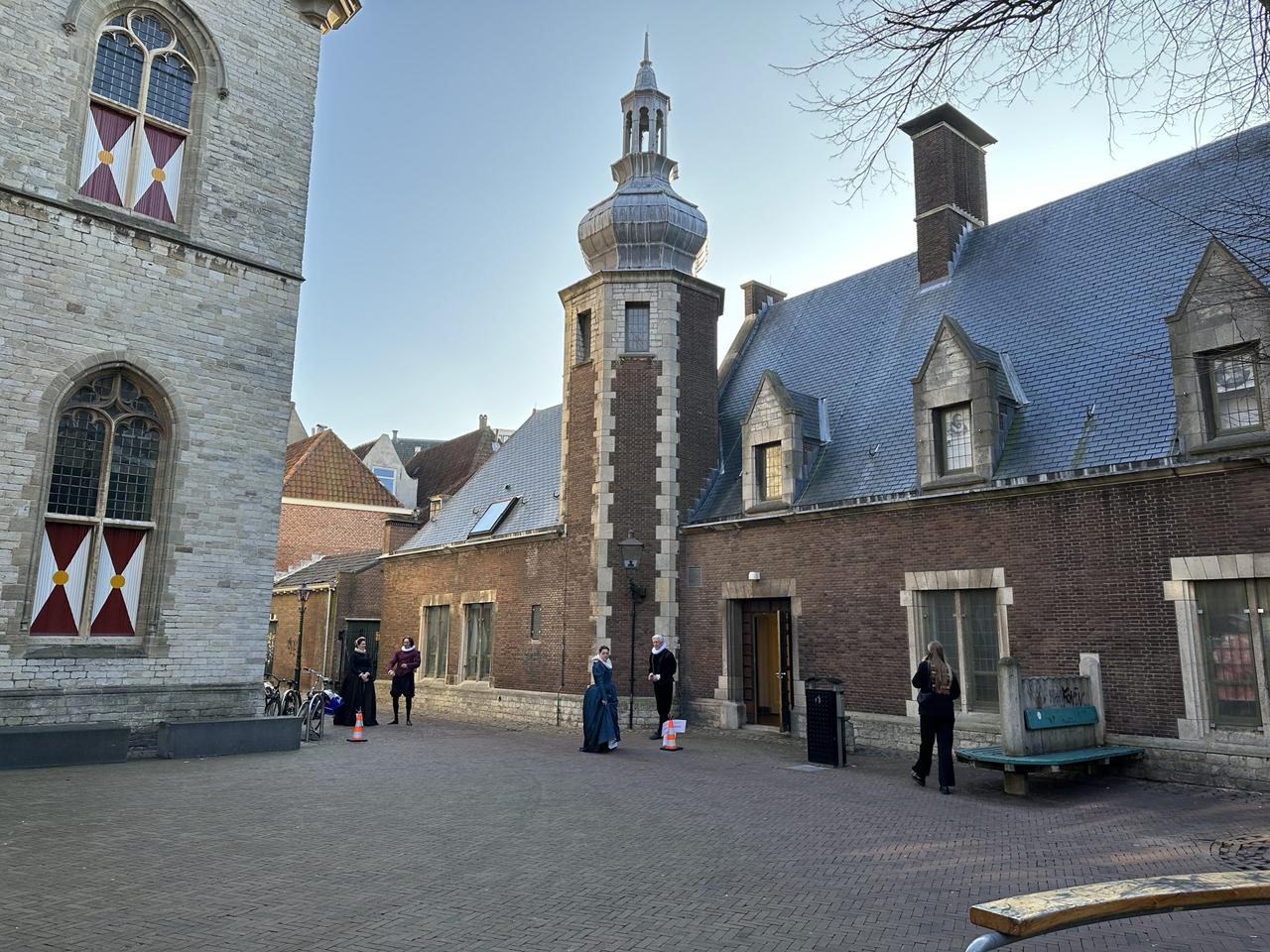
The Helm and the Observatory
We've walked a few steps around the town hall and we're now standing on the Helm, named after a grand inn that used to stand on this corner. Back around 1562, it rented for forty guilders a year.
What happened here is on a completely different level from inn history. In the autumn of 1608, a spectacle maker named Hans Lipperhey was walking around this neighbourhood when he discovered that two ground lenses placed one behind the other could bring distant objects up close. He applied for a patent, meaning the exclusive right to sell his invention. In September of that year, the States of Zeeland gave him a letter of recommendation to take to The Hague, where he demonstrated his device on the roof of Prince Maurits's residence.
The patent never came through, because the idea turned out to be too simple to protect and others copied it immediately. He did receive a commission to build three of them, for nine hundred guilders. Within a year the news had reached Italy, where Galileo Galilei built his own version and became the first person to use it to observe the moons of Jupiter.
His neighbour Zacharias Jansen later claimed that he had been the one to think up the telescope, which muddied the waters considerably. Jansen happened to be a convicted counterfeiter who had been making fake Spanish coins. Counterfeiting carried the death penalty, and the reason he escaped it was that the father of the bailiff assigned to prosecute him turned out to be an accomplice.
We walk to the end of the Helm and turn right into the Stadhuisstraat. At the Lange Noordstraat we turn left for a moment and then straight away right again, into the Bachtensteene. At the end we turn right into the Burggang and then left into the Kapoengang, and that's where we stop.
Any feedback for this story?