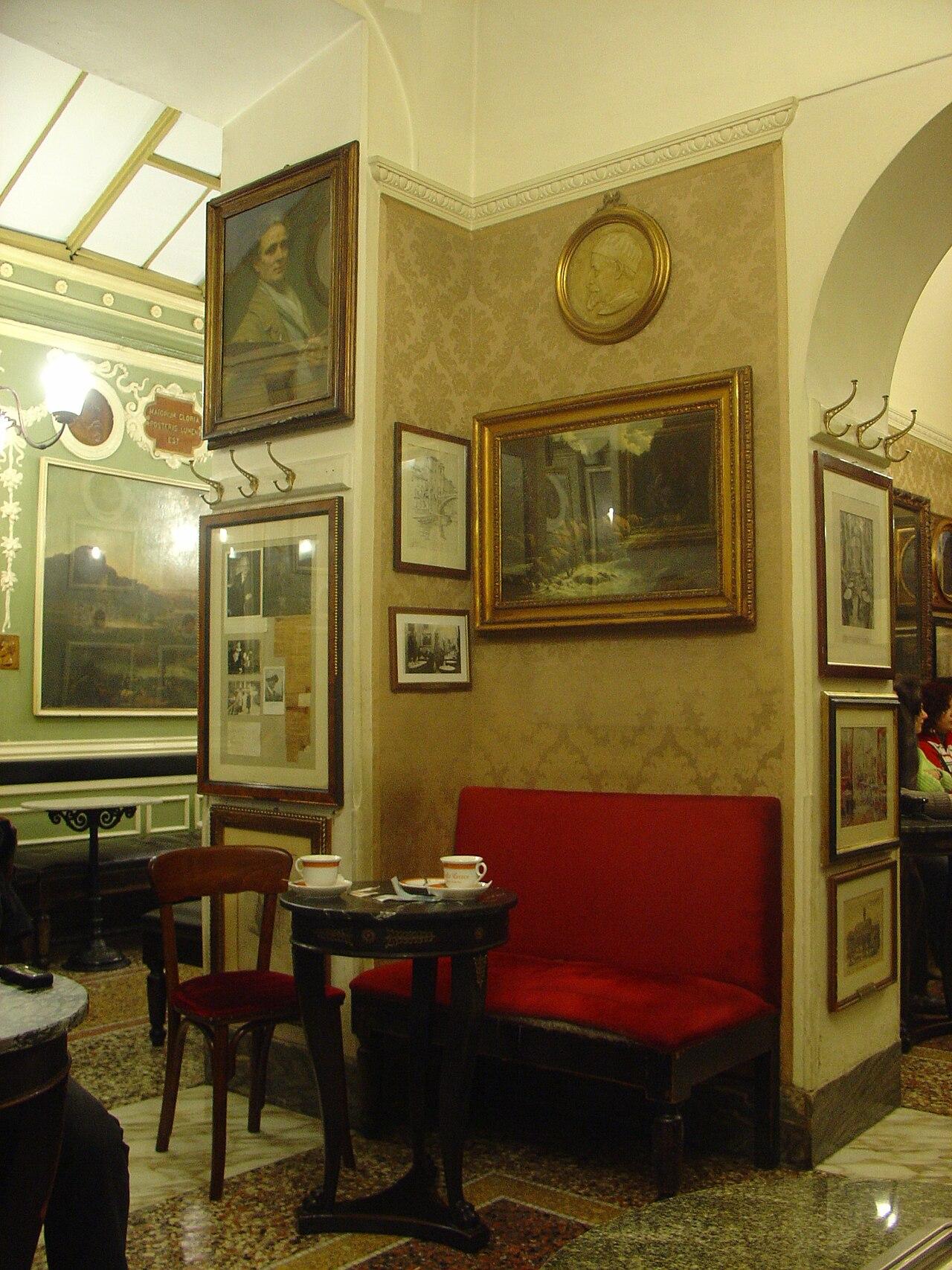
The Street of the Pipes
This street lined with fashion houses takes its name from something underground: the condotti, the conduits of the aqueduct that once fed the Trevi. The Acqua Vergine still runs beneath the pavement here on its way to the fountains of the neighbourhood, and when the line was repaired in the sixteenth century the street took the name of the pipes below it.
Behind a narrow door at number 86 sits the oldest working café in the city, opened in 1760 and named after its Greek founder. In the nineteenth century this was the living room for anyone who came to Rome on the Grand Tour. Goethe wrote here, Keats spent his final months at these tables, and Byron, Mendelssohn, Wagner and Stendhal all passed through. The walls are covered with what those guests left behind, more than three hundred paintings and drawings, and the whole place is listed as protected cultural heritage.
Keats died in 1821 in the house at the foot of the stairs where this walk began, just twenty-four years old, and he lies buried in the Protestant Cemetery near the pyramid, a place worth a walk of its own.
Thanks for coming along on this walk. There are more routes to find through Rome: the ancient heart from the Capitoline to the Circus Maximus, the Trastevere quarter across the river, and the feud between Bernini and Borromini that was left standing in stone.
We walk to the end of Via dei Condotti heading east, and after two hundred metres the steps stand before you again, with Spagna metro station just to their left. The fountain where you started is the last stretch of the same pipe that runs here beneath your feet.
Any feedback for this story?