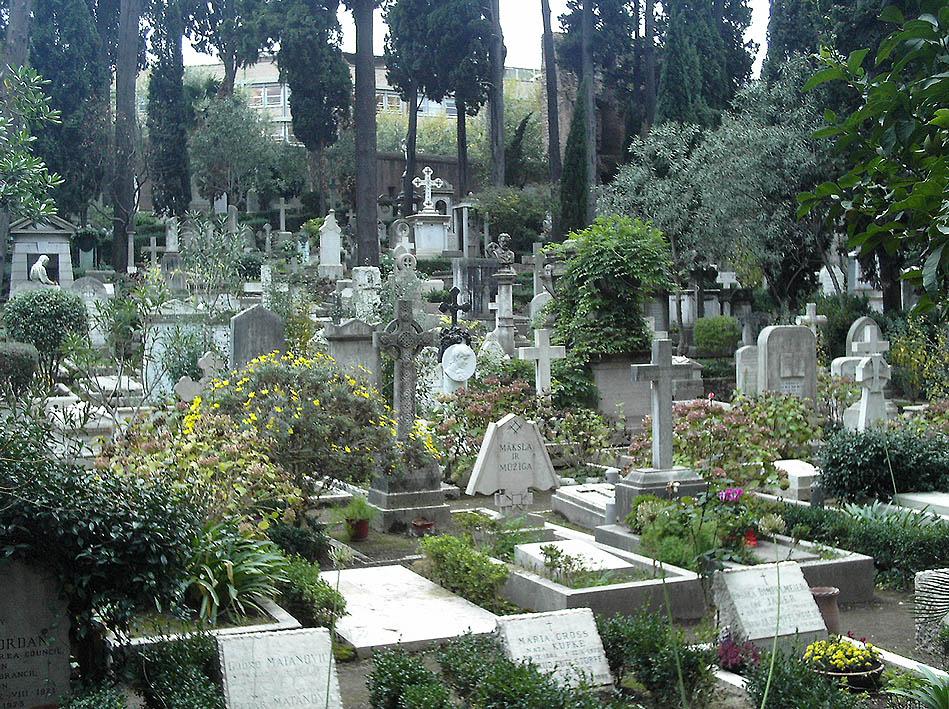
The Cemetery of the Foreigners
Behind this wall lies the quietest spot in Rome, and it is also where the city spent centuries burying everyone who didn't belong.
If you weren't Catholic, the papal city gave you no place in consecrated ground. From the eighteenth century onward this field beside the pyramid was used instead, for Protestants, for Orthodox Christians, for Jews who fell outside their own burial grounds, and later for anyone who came from somewhere else. At first the burials happened at night, to avoid disturbances.
The oldest part is an open meadow without paths. There lies John Keats, an English poet now counted among the greatest in his language, though during his life he mostly got bad reviews. He came to Rome in 1820 hoping the climate would ease his tuberculosis, and he died here a few months later, only twenty-four years old. His stone carries no name, because that was his own wish: it says only that here lies someone whose name was written in water. His friend the painter Joseph Severn, who cared for him until the end, lies beside him.
A little further on lies Percy Bysshe Shelley, of the same generation as Keats and just as famous after his death, married to Mary Shelley who wrote Frankenstein. He drowned in 1822 in a sailing accident off the Tuscan coast, thirty years old, and his stone bears words from Shakespeare's The Tempest, about something in the sea that suffers a rich and strange change.
Generations of cats have lived among the graves, cared for by volunteers, and they love to stretch out on the warm stones. Entry is free, with a voluntary donation at the gate.
We leave the cemetery and follow Via Caio Cestio to the end, out to the wide road, and we cross over toward the hill with the trees on top.
Any feedback for this story?