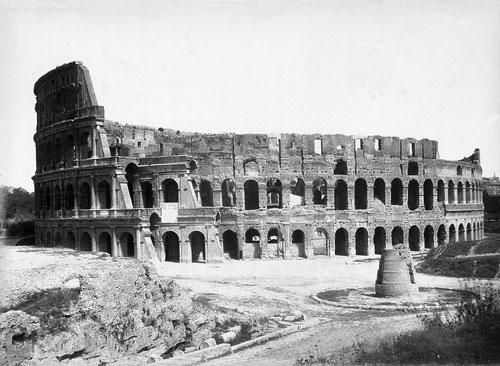
How the Colossus got its name
The Colosseum owes its name to a statue that stood here, and in the paving between the arena and the arch two shapes picked out in a different coloured stone mark where it vanished.
The larger one was the base of the Colossus of Nero, a bronze statue over thirty metres tall that the emperor had made of himself for his palace. After his downfall it was given a crown of sun rays and renamed as the sun god, and the emperor Hadrian later had it moved to this spot using twenty-four elephants. It stood here for centuries, and the amphitheatre next door picked up its nickname from that neighbour: the Colosseum is named after a statue that no longer exists.
The smaller outline belongs to the Meta Sudans, a cone-shaped fountain from the days of the emperor Titus, where water sweated its way down the sides. The remains were still standing until 1936, when they were demolished because they were in the way during the parades.
Between the Palatine and the Caelian we follow Via di San Gregorio south, until the long open field opens up on the right.
Any feedback for this story?