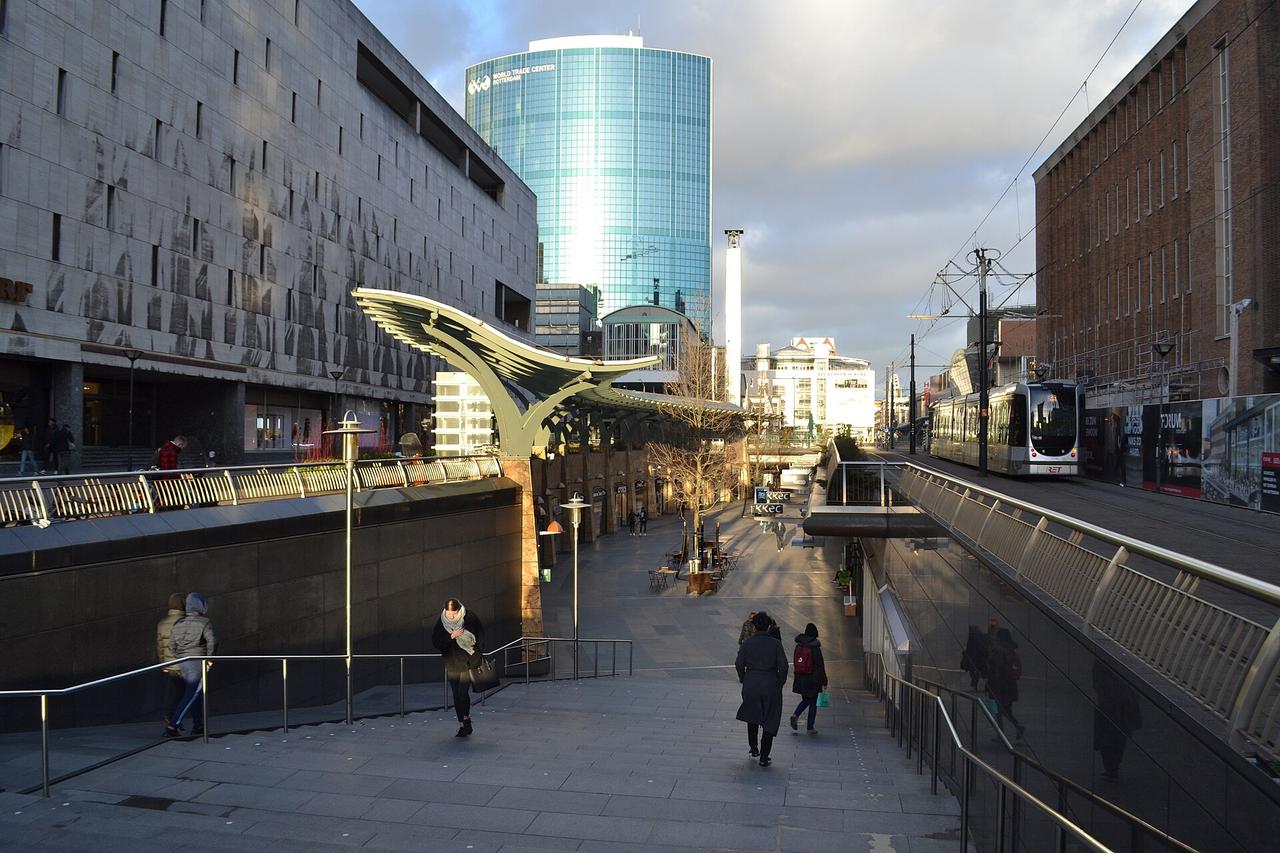
De Beurstraverse
De Koopgoot, as everyone calls it, was a correction to the Basisplan, Rotterdam's postwar reconstruction scheme. Van Traa had drawn the Coolsingel as a broad traffic artery, and that artery cut the Lijnbaan shopping promenade off from the Hoogstraat and the old retail district on the eastern side. For forty years you crossed here, dodging between the trams.
In 1996 Pi de Bruijn solved it by running the street beneath you: an open trench five metres deep with shops along both sides, daylight pouring in from above, and a direct link to the metro station. The flow of traffic up top stayed where it was, while the shopping area underneath grew together into one.
Above your head the trams run across a bridge that you'd hardly recognise as a bridge from down here. And on the eastern side, where we climb the steps again, stands the Beursgebouw, the stock exchange building by Jo van der Mey and J.F. Staal, finished in 1940 just as the city around it was wiped out. It held firm, and for decades afterwards it was the only prewar anchor in this corner.
From the Koopgoot we stick with the Coolsingel and head south, until the street opens onto a square lined with tall office blocks and named after a British prime minister.
Any feedback for this story?