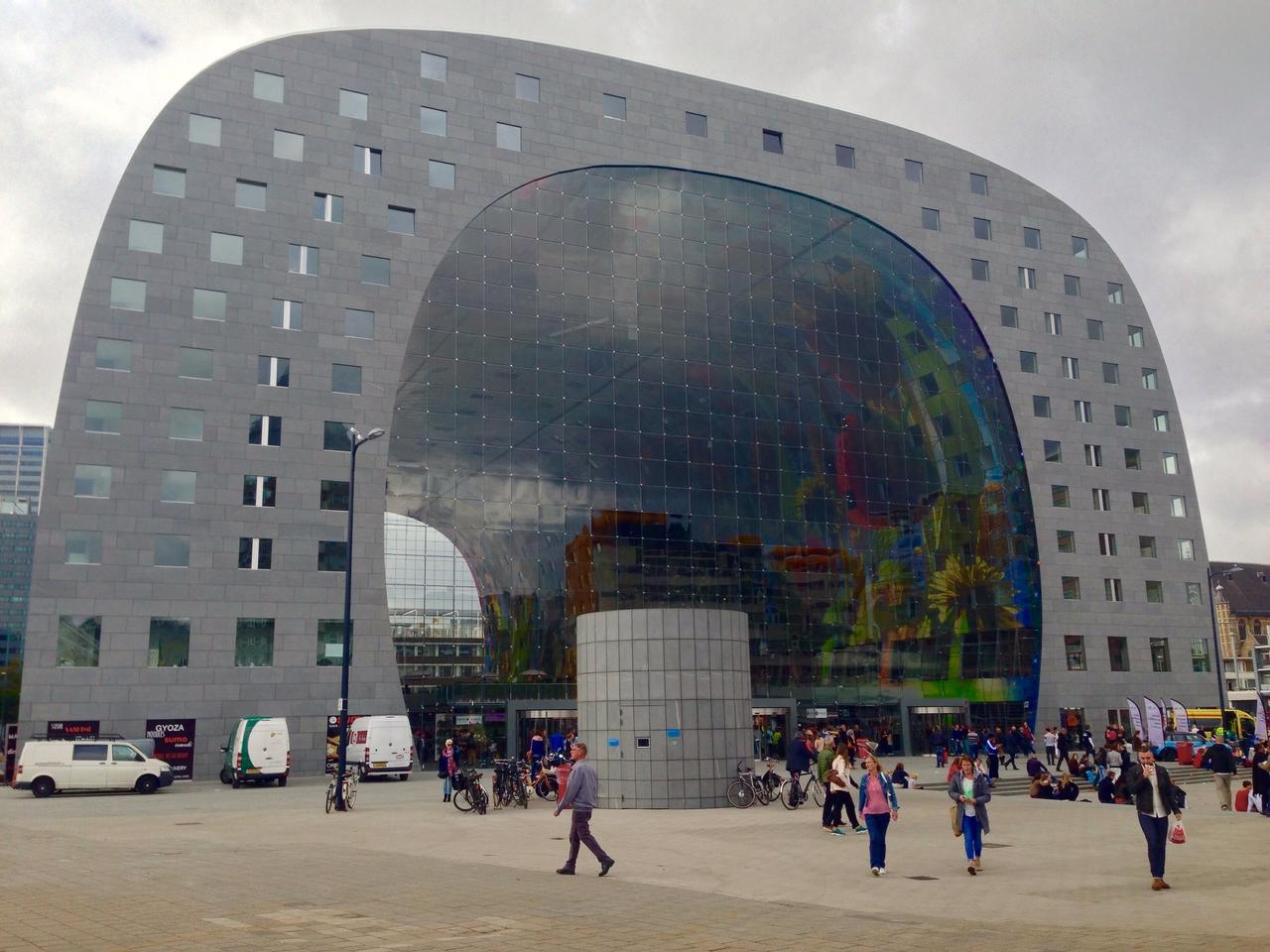
The Markthal
Rotterdam lost its old city centre in fourteen minutes of bombing in May 1940, and afterwards it chose something very different from rebuilding. The Markthal, opened in October 2014 by Queen Máxima, is the most photographed proof of that choice: an arch of apartments curving like a horseshoe over a covered market, with a glass facade at each end that hangs from steel cables and sways with the wind.
What made the hall famous hangs above the stalls. Eleven thousand square metres of ceiling, roughly two football pitches, are covered by the Horn of Plenty by Arno Coenen and Iris Roskam. They drew their fruit, fish, flowers and insects digitally, using the same animation technique that goes into cartoons, then had it printed on panels at an enormous scale. The whole thing is a wink to the Dutch still lifes of the seventeenth century, only now so large that a single cherry is the size of a car.
Under your feet lies an older Rotterdam. When the building pit was dug out in 2009, the city archaeologists hit a farmhouse from around the year one thousand, seven metres down, with the bones of cows, sheep and geese beside it. It was a remnant of Rotta, a village on the river Rotte that gave up on the water around 1050. The finds now sit in the Tijdtrap, the time staircase in the car park beneath the people eating above.
Any feedback for this story?