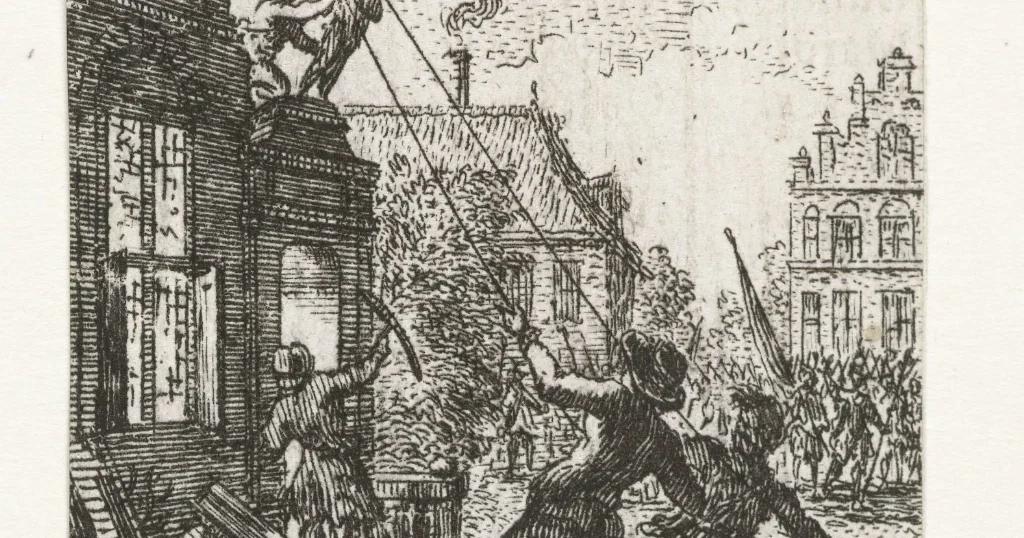
The Costerman Riot
Until May 1940, this spot held Rotterdam's town hall, a converted almshouse dating back to 1329, with its entrance on the Hoogstraat and its back facing the Kaasmarkt, roughly where the trams now run across the Binnenrotte. Right there, beside the town hall, the scaffold went up whenever someone was to be hanged or beheaded. In September 1690, a young naval cadet named Cornelis Costerman stood on it.
A few weeks earlier, he and his mates from the civic militia had bought a barrel of wine from an illegal trader to dodge the excise duty. When they were caught, things got out of hand and a man who had reported them was killed. Jacob van Zuylen van Nijevelt, the bailiff and the city's highest law officer, deeply loathed in Rotterdam for his extortion, forced a confession out of Costerman under threat of the rack and had him beheaded.
The executioner lost his nerve and turned it into a butchery, and that was the moment the city erupted. First the house of one of the tax farmers on the Kaasmarkt was plundered for hours, and on the fifth of October the crowd dragged cannon to the bailiff's house on the Leuvehaven and razed it to the ground. By then Van Zuylen had already fled, disguised as a militiaman. Two years later he was acquitted and simply reappointed by William III.
From here we walk down to the river, across the Blaak and then onto the quay towards the Boompjes.
Any feedback for this story?