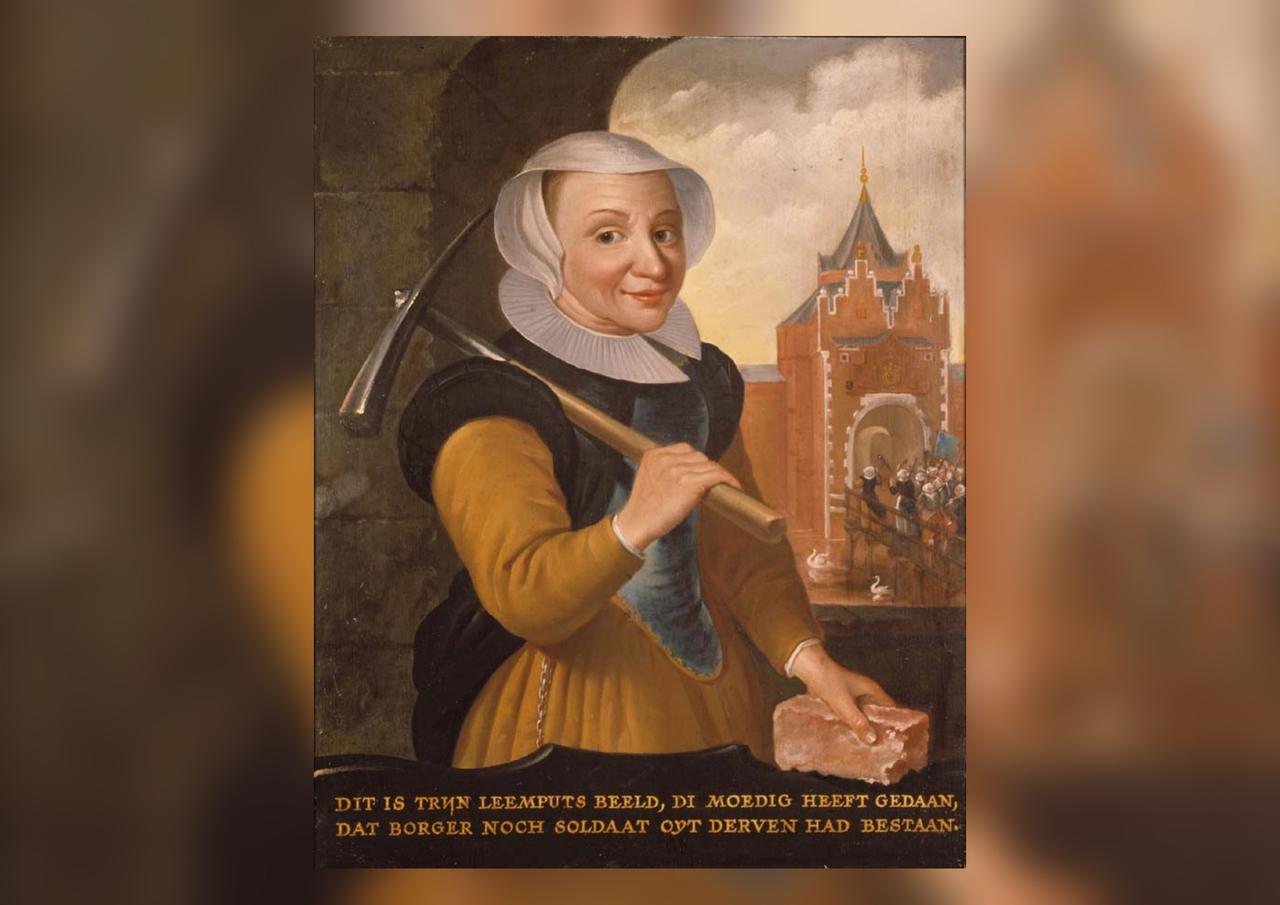
Trijn van Leemput
Welcome to Utrecht, and welcome to a walk past the people who made this city.
You are standing on a bridge over the Oudegracht, and beside you stands a woman in bronze with a banner in her hand. She is the best possible start for this route, because what she did was a criminal offence.
In the spring of 1577 there was a castle on the west side of the city that the people of Utrecht had never wanted there. Charles the Fifth had it built to keep the city in check, and once the Spanish garrison finally surrendered the thing simply stood there, empty. Demolishing it was not allowed, because the States of Utrecht did not dare act without permission from Spain.
On the evening of the second of May, Trijn van Leemput walked up to the wall with a group of other women and started on it herself. According to tradition she had tied a blue apron to a broomstick as her banner. The city followed her, and by the time official permission arrived months later there was hardly anything left to pull down.
She lived close to here on the Oudegracht, in a house called Die Vergulde Craen, and she is buried in the cathedral. For a long time people doubted whether she had really existed, until archive research found her again.
Over the next hour you walk south from here, past eight other people from Utrecht. They have one thing in common: none of them did what was expected of them. A monk from England who came to convert a people who had not asked for it. A scholar who entered a university that admitted no women. A pope who admitted that his own church was in the wrong. Painters who came back from Rome with a way of seeing that nobody here knew. A singer who wrote his songs in a dialect you were supposed to unlearn. And at the end a woman who, four hundred years after Trijn, did something that looks suspiciously similar.
We now walk along the Oudegracht and the Neude to the Janskerkhof.
Any feedback for this story?