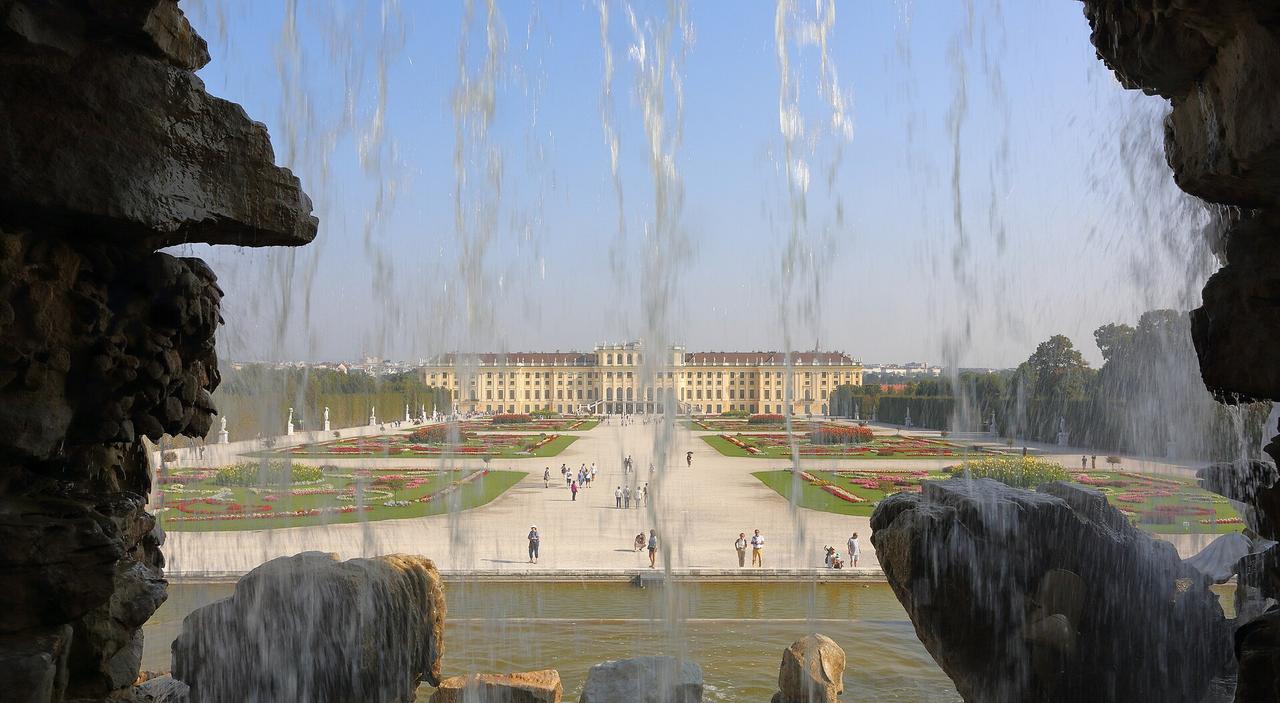
The fountain with the view
This is the one spot in the garden where you see the whole thing at once: up the slope to the colonnade of the Gloriette on the crest, and behind you the parterre running in a straight line towards the yellow facade of the palace.
That line is older than almost everything around it. In the first design by Johann Bernhard Fischer von Erlach, at the end of the seventeenth century, the palace was to stand on top of this hill with the garden falling away below it. The money reached less far than the ambition, the palace ended up down below, and the crest stayed empty until Maria Theresa had the Gloriette placed on it in the 1770s.
The fountain in front of you was built between 1776 and 1780 to a design by Johann Ferdinand Hetzendorf von Hohenberg, with figures in white Sterzing marble from the studio of the court sculptor Johann Wilhelm Beyer. Neptune sits enthroned on the rock with his trident, and Thetis kneels before him to ask for protection on the sea voyage of her son Achilles.
The reason it took so long is almost comic for a plan on this scale. Five fountains were meant to stand in the great parterre, and in 1777 it turned out the water supply would stretch to one basin only. The basins already dug were filled in again, and this one was left. It came into use in 1780, the last year of Maria Theresa's life.
We turn around and walk down the parterre, straight towards the yellow facade. The last stretch takes us around the palace to the courtyard at the front, a kilometre in all, and that is where this walk ends.
Any feedback for this story?