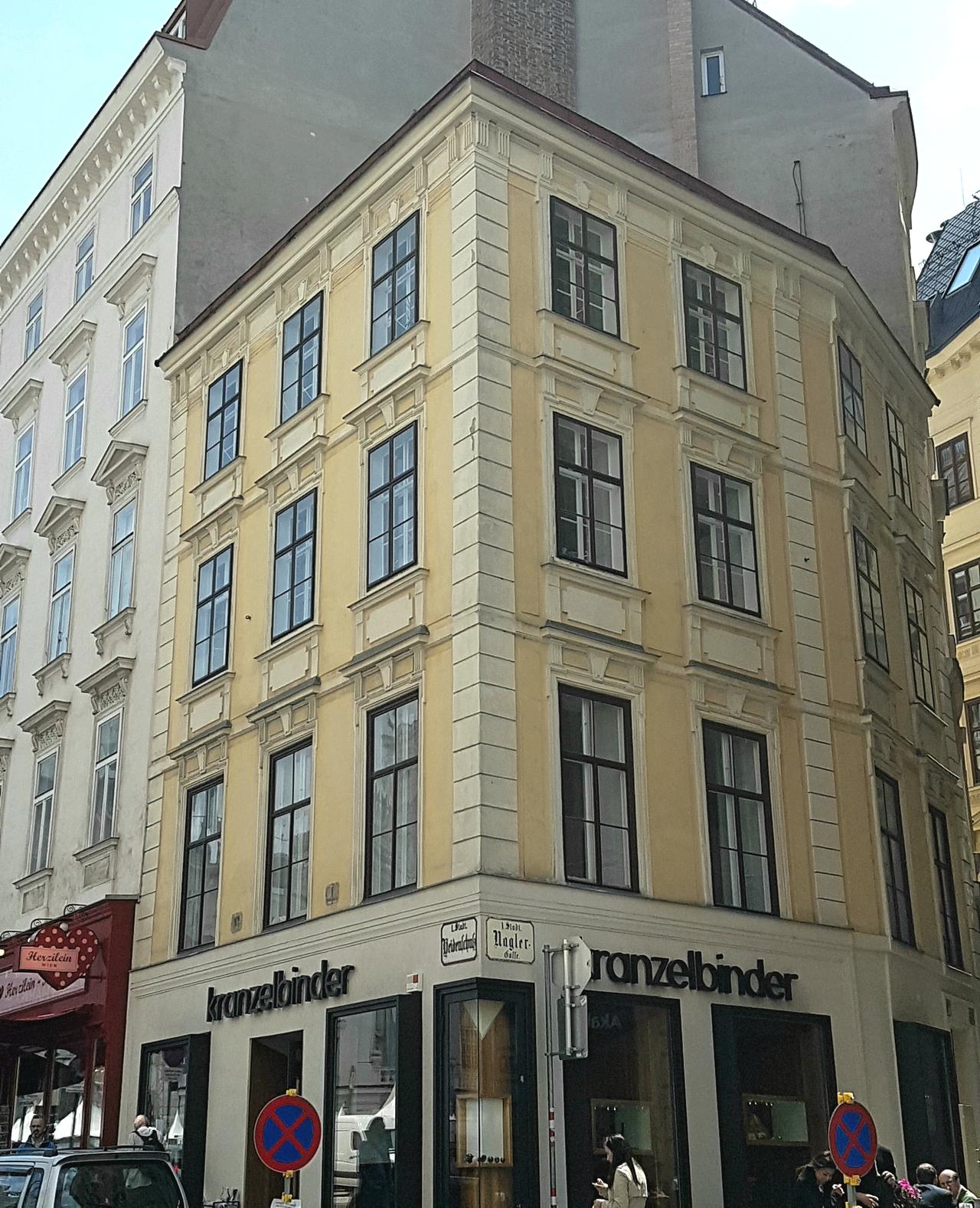
The Horseman on the Facade
A baker's apprentice was working in his cellar at night when he heard scraping under the floor. He raised the alarm, the city dug back, and the attack fell apart.
That tale belongs to this corner, where a stone horseman with a raised sabre hangs on the facade and the little street is named after him: Heidenschuss.
Two things about it don't add up. The legend is set during the first Ottoman siege of 1529, well over a century and a half before the one in 1683, and the house sign is older still than either of them. It already turns up in a document from thirteen sixty-five, and what it originally referred to is something nobody remembers anymore.
The technique behind it, though, was real enough. Anyone living close to the wall had to put open barrels of water in their cellar and set out drums with peas laid on top, because if that water rippled or those peas jumped, someone was digging under your house. That's how a whole city kept watch over itself, cellar by cellar, and defending Vienna began with listening to the ground.
A hundred metres further on, the Freyung opens up, the square of a monastery with a name that makes no sense at all.
Any feedback for this story?