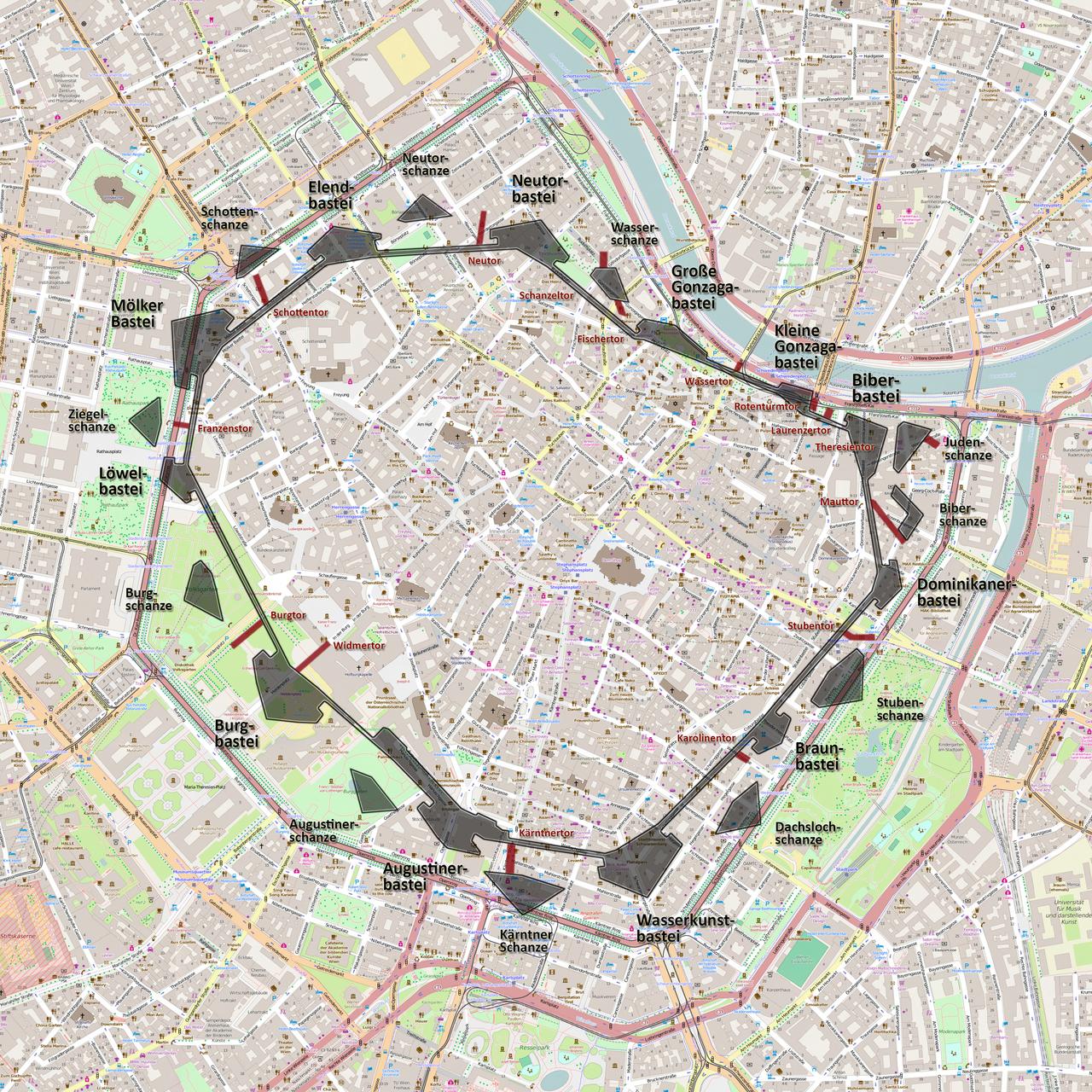
The field that had to stay empty
The reason Vienna has a boulevard this wide is that for centuries the law forbade anything from standing here.
Beyond the fortress wall lay a bare strip a few hundred metres across, the glacis, and anyone who built something there could count on a visit from the city's demolition crew. The defenders had to see everything coming from the ramparts, so no house, no barn and no orchard was allowed to give an attacker cover. In 1683 that bare strip proved its worth, because the Ottomans had to dig their way across it with trenches while the cannons stayed trained on them.
Once the danger faded, the emptiness became a parade ground and then a walking park with lanterns and rows of trees, where on Sundays the Viennese strolled along the very spot where their great-grandparents had once been shot at.
In 1857 Emperor Franz Joseph decided the fortress could go. Because the whole area was already empty and in a single pair of hands, the Ringstraße could be designed all at once, with the opera house, the parliament, the city hall and the university lined up in a row. So a military rule from the sixteenth century still shapes what the centre of Vienna looks like today.
Along the Ring, towards the Volksgarten, you'll find the street named after the bastion where it all went wrong in September 1683.
Any feedback for this story?